

Inbody-270-Assessment
Written by: Wayne Larsen, Certified Strength and Conditioning Specialist, Unite Fitness Retreat
What Does an InBody Scan Measure? Inside Your Unite Fitness Retreat Assessment
If you’ve looked into weight loss retreats at all, you’ve probably seen “InBody assessment” listed somewhere in the program description and wondered what it actually involves. Is it a scale? A blood draw? Something you need to prepare for? And once it’s done, what do all those numbers on the printout actually tell you?
Here’s the short version: the InBody 270 is the body composition scan we use to build your baseline on day one and to track exactly what’s changing, week over week, for the rest of your stay. It’s not a scale. It’s not a guess. It’s a 30-second, non-invasive test that tells us — and you — precisely how much of your body is muscle, fat, and water, and where.
TRANSFORMATION SPECIAL | CALL NOW: 1-844-864-8388
What is the InBody 270, exactly?
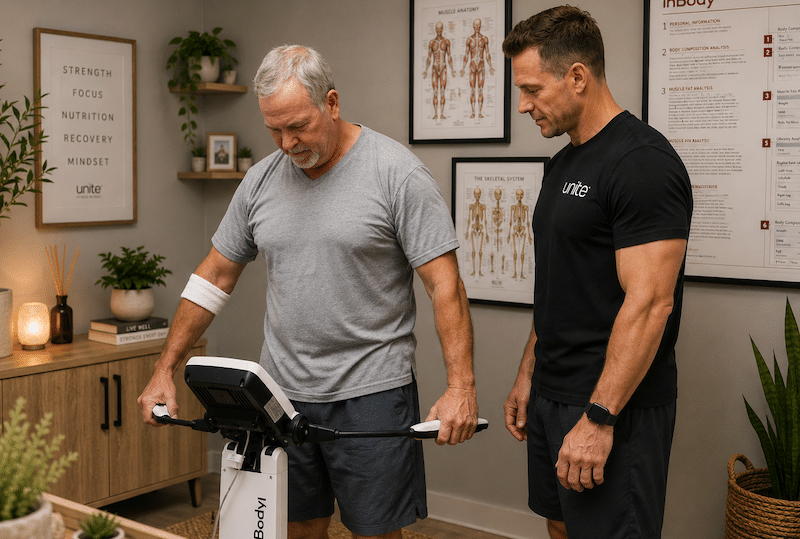
The InBody 270 is a professional-grade body composition analyzer that uses bioelectrical impedance analysis (BIA) — a safe, painless electrical current sent through your body via hand and foot electrodes — to measure how that current moves through muscle, fat, and water. Muscle holds more water than fat, so it conducts the current differently, and the device uses that difference to calculate your body composition in about 30 seconds.
Two things make it meaningfully more useful than a bathroom scale or a tape measure:
- It doesn’t guess based on averages. Cheaper scales estimate your body fat using statistical formulas built on age, sex, and general population data. The InBody 270 uses Direct Segmental Multi-Frequency BIA, which measures your arms, legs, and trunk independently rather than applying a population-wide assumption to your whole body.
- It shows you where, not just how much. Two guests who lose the same 10 pounds can have completely different stories underneath — one may have lost mostly fat, the other mostly muscle and water. The InBody 270 is what lets us see that difference and adjust your program accordingly.
You simply stand on the base, hold the hand electrodes, and stay still for about 30 seconds. No fasting requirements beyond the standard prep tips below, no needles, no discomfort.
Everything the InBody 270 tests
Our InBody 270 tracks 20 individual metrics, organized into a few core categories. Here’s what each one actually means.
The four building blocks of your weight
Every pound on the scale is made up of four things, and this is the foundation the rest of the report is built on:
- Total Body Water (TBW) — the water weight in your body, typically 50–65% of total weight.
- Dry Lean Mass — the weight of protein and minerals in your body (mostly muscle tissue, plus bone).
- Body Fat Mass — total fat weight, including both the fat just under your skin and the fat surrounding your organs.
- Weight — the sum of the three above.
Water balance
- Intracellular Water (ICW) — water held inside your cells.
- Extracellular Water (ECW) — water held outside your cells, in blood plasma and the space between cells.
- ECW/TBW Ratio — the balance between the two. This ratio is one of the more clinically useful numbers on the sheet because a skewed ratio can flag inflammation, poor recovery, or hydration issues before they show up anywhere else.
Muscle-fat analysis
- Skeletal Muscle Mass (SMM) — the muscle attached to your bones that you build through training. This is the number that matters most if your goal is body recomposition, not just weight loss.
- Lean Body Mass (LBM) — everything in your body that isn’t fat: muscle, water, bone, and organs. Also called Fat-Free Mass.
Obesity analysis
- BMI — the standard height-to-weight ratio. We include it because it’s still widely used in research, but on its own it can’t distinguish muscle from fat, which is exactly why it’s paired with the next metric.
- Percent Body Fat (PBF) — your fat mass as a percentage of total weight. This is a far more accurate read on your actual health and physique than BMI alone.
Segmental Lean Analysis
The InBody 270 measures lean mass separately in five segments — right arm, left arm, trunk, right leg, and left leg — instead of giving you one number for your whole body. This catches side-to-side imbalances (useful for injury history or old compensations) and shows us exactly where your resistance training is working and where it still needs attention.
The metrics that guide your program the most
- Visceral Fat Level (VFL) — the fat stored around your internal organs, as opposed to just beneath the skin. Visceral fat is disproportionately linked to metabolic health risk, and it’s possible to have a “normal” BMI while still carrying an elevated VFL. This is often the single most important number on the sheet for long-term health outcomes.
- Basal Metabolic Rate (BMR) — an estimate of how many calories your body burns at rest just to keep your heart beating and your lungs breathing. Because BMR is calculated from your lean mass rather than a generic formula, it becomes more accurate — and typically rises — as you build muscle during your stay.
- InBody Score — a single composite score from 0–100 summarizing your overall muscle-fat-water balance. It’s a useful number to watch trend upward over your stay, but we’ll always look at the individual metrics behind it rather than treating the score itself as the goal.
- Body Composition History — the InBody 270 stores your last several scans so we can chart your weight, skeletal muscle mass, and percent body fat side by side and see your actual trajectory, not just a single snapshot.
How the assessment works during your stay at Unite
Your first InBody scan happens as part of your intake on day one, alongside the rest of your baseline health and fitness evaluation. That scan becomes the reference point for everything that follows — your training program, your nutrition targets, and how we measure whether what we’re doing is actually working.
From there, you’re rescanned on a regular weekly cadence throughout your program. This is what lets your trainers and dietitians make real adjustments instead of guessing: if skeletal muscle mass is climbing and body fat is dropping, we know the current plan is working. If water balance shifts unexpectedly or visceral fat isn’t moving the way we’d expect, that’s information we act on in real time, not something you find out about after you’ve gone home.
A few things help your results stay consistent scan to scan:
- Test at a similar time of day when possible, ideally before a workout rather than after.
- Come normally hydrated — not dehydrated, but avoid chugging water right beforehand.
- Avoid testing immediately post-exercise, since blood flow shifts can temporarily skew the reading.
None of this requires real preparation on your part beyond showing up — our staff walks you through it and standardizes conditions as much as possible so the trend line, not any single data point, is what you’re watching.
Why this matters more than the number on the scale
A scale can’t tell you whether the 8 pounds you lost this week came from fat or muscle. For guests coming off GLP-1 medications, that distinction is especially important, since a portion of GLP-1-related weight loss can come from lean mass rather than fat. Weekly InBody scans are exactly how we confirm your resistance training and protein intake are protecting the muscle you have while your fat mass drops.
It’s also how we back up what guests can already feel in their bodies. When someone tells us they feel stronger and more capable partway through their stay, the InBody data is usually what confirms it in numbers — climbing skeletal muscle mass, a rising InBody Score, a falling visceral fat level — rather than asking anyone to just take our word for it.
TRANSFORMATION SPECIAL | CALL NOW: 1-844-864-8388
Frequently asked questions
What does an InBody scan measure?
The InBody 270 measures body weight, total body water (broken into intracellular and extracellular water), skeletal muscle mass, body fat mass, percent body fat, BMI, visceral fat level, basal metabolic rate, and lean mass in each of five body segments (both arms, both legs, and your trunk), along with a composite InBody Score. In total, our InBody 270 tracks 20 individual data points per scan.
How accurate is an InBody scan?
InBody devices are generally considered highly accurate for tracking body composition changes over time, with published comparisons to DEXA scans showing strong correlation, particularly for lean mass. As with any bioelectrical impedance device, an individual reading carries some margin of error, and factors like hydration and recent exercise can shift a single result. That’s exactly why we test under consistent conditions and look at your trend across multiple weekly scans rather than any one number in isolation.
How often will I be scanned during my stay at Unite?
You’ll receive a baseline InBody assessment on day one as part of your intake evaluation, followed by weekly scans throughout your program so your trainers and dietitians can track real changes and adjust your plan accordingly.
Do I need to do anything to prepare for my InBody assessment?
Not much — our staff standardizes testing conditions for you. Coming normally hydrated and avoiding a scan immediately after an intense workout helps keep results consistent, but there’s no fasting or special preparation required.
What is a good InBody Score?
InBody Scores are typically interpreted as: below 70 is below average, 70–79 is average, 80–89 is good, and 90+ reflects an athletic level of muscle-fat-water balance. The number itself matters less than its direction — a rising score over your stay reflects real gains in muscle and reductions in fat.
What is visceral fat level, and why does it matter?
Visceral fat is the fat stored around your internal organs, as opposed to the fat just beneath your skin. It’s independently linked to metabolic health risk, and it’s possible to carry an elevated visceral fat level even with a normal BMI. A Visceral Fat Level under 10 is generally considered a healthy range, and it’s one of the metrics we watch most closely across your weekly scans.
Curious what your own InBody numbers would show? Book a consultation and we’ll walk you through exactly what a baseline assessment at Unite looks like.