

Why Weight Loss Plateaus Happen
Why Weight Loss Plateaus Happen — and What to Change First
A weight loss plateau happens when the eating, movement and lifestyle habits that initially created weight loss are no longer producing the same result—often because your smaller body requires less energy, activity has subtly changed, hunger has increased, or your body composition is changing in ways the scale can’t show.
Key Takeaways
- Weight loss plateaus are common and do not automatically mean your metabolism is “broken.”
- As you lose weight, a smaller body generally requires fewer calories than it did at a higher weight.
- Your body may also respond to weight loss by conserving some energy and increasing hunger—a process sometimes described as metabolic adaptation or adaptive thermogenesis.
- People often move less outside of workouts during a calorie deficit without realizing it.
- A stalled scale does not always mean fat loss has stopped. Water, muscle, inflammation, hormones and digestion can temporarily hide progress.
- Before cutting calories further, look at consistency, protein, strength training, everyday movement, sleep and recovery.
- Body composition can often tell you more than scale weight alone.
- If a plateau persists despite consistent habits—or weight changes are unexplained—talk with a qualified healthcare professional.
You started eating differently.
You began exercising.
Maybe the first few weeks felt almost easy.
Two pounds down.
Another pound.
Clothes fitting better.
Energy improving.
And then…
Nothing.
The scale stays exactly where it is.
Monday.
Wednesday.
Saturday.
Still there.
This is the point where many people decide they need to eat even less and exercise even more.
But before you cut another 300 calories or add an hour of cardio to your day, it’s worth understanding something:
Weight loss plateaus are a normal part of losing weight.
Your body isn’t necessarily fighting you.
And your metabolism probably isn’t “broken.”
More often, the conditions that originally created weight loss have changed.
Understanding why is the first step toward deciding what to change next.
What Is a Weight Loss Plateau?
A weight loss plateau is a period when your weight stops trending downward despite continuing many of the habits that previously resulted in weight loss.
That can be incredibly frustrating.
But physiologically, it makes sense.
If you begin at 220 pounds and eventually weigh 190 pounds, your body is now maintaining a smaller amount of tissue.
It generally takes less energy to move and maintain a 190-pound body than a 220-pound body.
The National Institute of Diabetes and Digestive and Kidney Diseases explains that metabolism slows during weight loss and the body requires fewer calories at a lower weight. Hormonal changes and other adaptations can also make continued weight loss and long-term maintenance more challenging.
That’s one reason the same plan doesn’t necessarily produce the same rate of weight loss indefinitely.
Why Do Weight Loss Plateaus Happen?
There usually isn’t one single reason.
It’s often a combination of several smaller changes.
Let’s break down the most common ones.
1. A Smaller Body Needs Less Energy
This is the simplest explanation—and one of the most overlooked.
Imagine carrying a 25-pound backpack everywhere you go.
Walking upstairs.
Walking through Costco.
Going for a hike.
Doing laundry.
Getting out of a chair.
Now imagine taking that backpack off.
Those activities require slightly less energy.
Weight loss works similarly.
As body mass decreases, the energy required to move and maintain your body generally decreases too.
So the eating pattern that produced a calorie deficit at your starting weight may eventually create a much smaller deficit.
Or none at all.
That doesn’t mean you did anything wrong.
Your body changed.
Your plan may simply need to change with it.
2. Your Body Can Become More Energy Efficient
There is another piece of the equation known as adaptive thermogenesis or metabolic adaptation.
During periods of calorie restriction and weight loss, energy expenditure can sometimes decrease beyond what would be predicted from the change in body size alone.
Researchers continue to study the size and clinical significance of this effect, and it varies substantially from person to person.
But the basic concept is important:
Your body is designed to adapt.
NIDDK describes physiological adaptations following weight reduction that can decrease energy expenditure and increase the drive to eat, both of which can make maintaining continued weight loss more challenging.
That doesn’t mean:
“My body is in starvation mode, so losing weight is impossible.”
It means the human body is remarkably good at trying to maintain energy balance.
And that’s very different.
3. You May Be Moving Less Without Realizing It
Your workout is only one portion of your daily movement.
There’s also everything else you do:
- Walking through the grocery store
- Taking the stairs
- Standing
- Cleaning
- Gardening
- Walking the dog
- Pacing during a phone call
- Getting up from your desk
- Fidgeting
Researchers often group this type of movement under non-exercise activity thermogenesis, commonly shortened to NEAT.
When people are eating fewer calories, they may become tired and unconsciously reduce this everyday movement.
You still completed your workout.
But maybe you sat for three more hours afterward.
Your body can become efficient in very subtle ways.
What to change first
Don’t immediately add another punishing workout.
First ask:
How much am I moving during the rest of my day?
A daily walk or simple step goal can sometimes be more sustainable than continually adding high-intensity exercise.
4. Your Portions May Have Quietly Changed
This one isn’t metabolic.
It’s human.
When people first begin a nutrition plan, they’re often highly attentive.
They measure.
They plan meals.
They pay attention to portions.
Three months later?
The tablespoon of peanut butter has become a generous tablespoon.
The handful of almonds has become two.
The weekend has gotten a little looser.
Cooking oils aren’t being counted.
Restaurant meals happen more often.
None of these foods are inherently “bad.”
But small amounts of additional energy can accumulate.
And as your body becomes smaller and your calorie needs decrease, the margin becomes narrower.
What to change first
Before cutting your calories drastically, spend three to seven days simply observing.
Record:
- Meals
- Snacks
- Beverages
- Alcohol
- Restaurant meals
- Cooking oils and sauces
- Weekend eating
Not forever.
Just long enough to see whether your current habits match what you think you’re doing.
The CDC specifically recommends tracking nutrition, activity, sleep and stress as a way to understand where you are before deciding what needs to change.
5. You’re Doing More Cardio but Not Enough Strength Training
This is where the number on the scale can become misleading.
When the goal becomes:
“Burn as many calories as possible.”
People often increase cardio while simultaneously eating less.
But during intentional weight loss, we also need to think about muscle preservation.
Muscle is valuable tissue.
It supports:
- Strength
- Mobility
- Balance
- Physical independence
- Exercise performance
- Healthy aging
And if you’re losing weight, the goal should ideally be to lose more fat and preserve as much useful lean tissue as possible.
That’s why resistance training deserves a central place in a sustainable weight-loss program.
The CDC recommends adults get at least 150 minutes of moderate-intensity aerobic activity per week plus muscle-strengthening activity on at least two days per week for general health.
What to change first
Instead of asking:
“How can I burn another 400 calories?”
ask:
“Am I giving my body a reason to maintain muscle?”
That might mean improving your strength-training program before simply adding more cardio.
6. You’re Losing Fat—but the Scale Is Hiding It
This one surprises people.
Scale weight isn’t body fat.
Your weight also includes:
- Muscle
- Water
- Glycogen
- Bone
- Organs
- Food and waste in your digestive tract
That means your scale can stay flat even while meaningful changes are happening underneath.
For example:
You begin resistance training.
You lose some body fat.
You preserve or build lean tissue.
Your muscles store additional glycogen and water.
The scale barely moves.
You think:
Nothing is happening.
But your waist is smaller.
Your clothing fits differently.
Your strength has increased.
That is not failure.
That is why we encourage people to look at body composition, not simply body weight.
At Unite Fitness Retreat, we use the InBody 270 to track changes in body fat, skeletal muscle and body water throughout a guest’s stay.
Unite currently uses body-composition assessments as part of its broader effort to distinguish pounds lost from changes in fat and lean mass.
Learn More about our assessment process.
7. Sleep May Be Working Against Your Plan
Sleep tends to get treated like a wellness bonus.
It’s not.
If you regularly sleep five hours and then attempt to compensate with another workout and less food, you’ve missed an important part of the picture.
Insufficient sleep can influence:
- Hunger
- Appetite
- Energy
- Recovery
- Exercise performance
- Food choices
- Motivation
Perhaps most practically:
When you’re exhausted, healthy behaviors become harder to maintain.
The CDC includes adequate sleep alongside healthy eating, physical activity and stress management as part of healthy weight loss.
What to change first
Before changing your calories, look at your last seven nights.
Not your ideal bedtime.
Your actual sleep.
8. Chronic Stress Can Make Consistency Harder
Stress does not magically create body fat out of thin air.
But it can influence the behaviors surrounding weight management.
Chronic stress may affect:
- Sleep
- Hunger
- Emotional eating
- Alcohol intake
- Energy
- Motivation
- Recovery
- Food choices
And this is something traditional “eat less, move more” advice often misses.
Sometimes someone’s plan is technically perfect.
Their life just makes it nearly impossible to follow.
Stress management is part of the CDC’s broader healthy-weight framework for exactly that reason.
At Unite, mindfulness, recovery, life coaching, time outdoors, yoga and intentional downtime are part of the program because behavior happens inside a real life, not on a spreadsheet.
9. You’re Expecting Weight Loss to Be Linear
This may be the most important expectation to change.
Weight loss rarely looks like this:
204 → 203 → 202 → 201 → 200 → 199
Real life often looks more like:
204 → 202 → 203 → 201 → 201 → 200 → 201 → 198
Body weight fluctuates.
Salt.
Carbohydrates.
Menstrual cycles.
Exercise inflammation.
Travel.
Restaurant meals.
Constipation.
Hydration.
All can temporarily change scale weight.
That means a few days without movement isn’t necessarily a plateau.
Look at the trend over several weeks, not one Monday morning.
What Should You Change First When Weight Loss Stalls?
This is where people tend to make things harder than necessary.
A plateau does not mean you should change everything at once.
If you simultaneously:
- Cut carbohydrates
- Cut calories
- Add HIIT
- Start fasting
- Increase steps
- Stop eating after 6 p.m.
- Take three supplements
…and then your weight changes…
You have no idea what actually helped.
Instead, troubleshoot systematically.
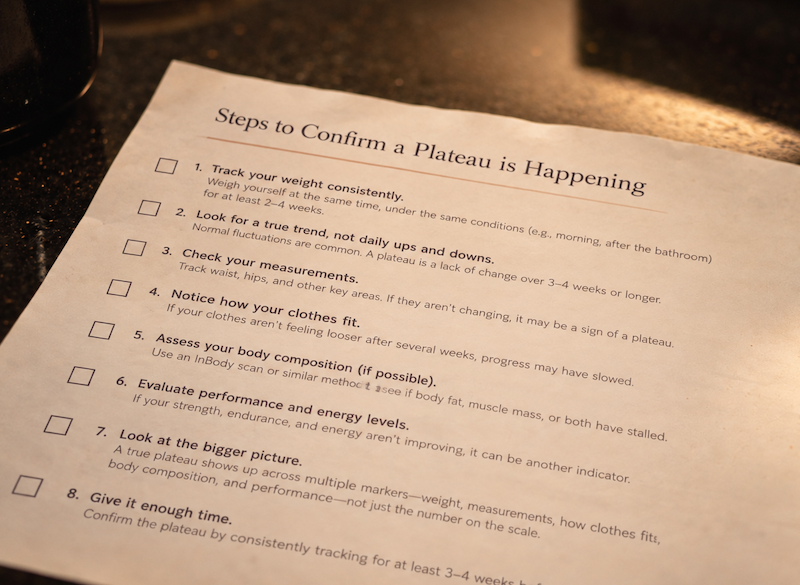
Step 1: Confirm That It’s Actually a Plateau
Give your data enough time.
A few days without scale movement isn’t meaningful.
Look at:
- Weekly average weight
- Waist circumference
- Body composition
- Clothing fit
- Strength
- Fitness
If body fat is decreasing while the scale is stable, you may not need to change anything.
Step 2: Recheck the Basics
Before changing calories, ask:
Am I following the plan consistently?
Not perfectly.
Consistently.
Look honestly at:
- Weekends
- Restaurant meals
- Alcohol
- Portions
- Snacks
- Liquid calories
- Cooking oils
- Grazing
You may discover you don’t need a new diet.
You simply need to tighten up the one that was already working.
Step 3: Prioritize Protein
Protein can be particularly useful during intentional weight loss because it supports lean tissue and helps with satiety.
Start by asking:
Is there a meaningful source of protein at most meals?
At Unite, chef-prepared meals are intentionally built around lean protein, vegetables and balanced nutrition rather than extreme restriction.
Internal link: Nutrition at Unite Fitness Retreat
Step 4: Strength Train Before You Add Endless Cardio
If your program consists almost entirely of cardio, this is one of the first things I would reconsider.
Progressive resistance training helps you maintain and build physical capacity while losing weight.
That could include:
- Squats
- Rows
- Presses
- Deadlift variations
- Lunges
- Step-ups
- Pulldowns
- Carries
The exact exercises depend on your ability and injury history.
The point is progression.
Give your muscles a reason to stay.
Step 5: Increase Everyday Movement
Instead of immediately adding another formal workout, consider something simpler.
Walk after lunch.
Walk after dinner.
Park farther away.
Take a ten-minute movement break between meetings.
Stand when you’re on the phone.
Add another hike on the weekend.
Small amounts of movement accumulated across the day can matter.
Step 6: Look at Sleep and Recovery
If you’re sore every day, exhausted, irritable and sleeping poorly, more exercise isn’t automatically the answer.
Sometimes improving recovery allows you to train better and remain more consistent.
Ask:
- Am I sleeping enough?
- Do I have rest between difficult workouts?
- Am I constantly sore?
- Am I taking recovery seriously?
- Am I giving myself any downtime?
Recovery isn’t laziness.
It’s part of training.
Step 7: Only Then Consider a Small Nutrition Adjustment
If you’ve confirmed that:
- Your weight trend has genuinely stalled
- Your body composition isn’t improving
- You’re eating consistently
- You’re strength training
- You’re moving daily
- Sleep and recovery are reasonable
then it may be appropriate to adjust food intake.
That doesn’t mean slashing calories.
Often a small, sustainable change is more useful than another dramatic diet.
The CDC recommends gradual weight loss—about 1 to 2 pounds per week—and notes that people who lose weight at a gradual, steady pace are more likely to maintain it than people who lose weight more rapidly.
What NOT to Do When You Hit a Weight Loss Plateau
Don’t immediately cut out an entire food group
Carbohydrates aren’t automatically the problem.
Neither is fruit.
Neither is eating after 7:01 p.m.
Look at the whole pattern first.
Don’t double your workouts overnight
More training requires more recovery.
There is a point where additional exercise simply creates additional fatigue.
Don’t assume the lowest possible calorie intake is the best one
Your goal is not to figure out the smallest amount of food you can survive on.
It’s to find an approach that supports fat loss, nutrition, muscle, exercise and real life.
Don’t change plans every five days
Bodies need time.
Programs need time.
Constantly jumping between approaches makes it impossible to know what actually works for you.
Don’t let one number determine whether you’re succeeding
Scale weight matters.
But so do:
- Fat loss
- Muscle
- Strength
- Waist circumference
- Fitness
- Health markers
- Energy
- Habits
When a Weight Loss Plateau May Need a Medical Conversation
Sometimes a plateau isn’t simply a programming issue.
Body weight can also be influenced by:
- Medications
- Hormonal changes
- Menopause
- Thyroid disorders
- Diabetes
- Other medical conditions
- Major sleep disruption
- Significant stress
The CDC notes that medications, medical conditions, genes, hormones, environment, stress and age can all affect weight management.
If your weight changes are unexplained, symptoms have changed, or you’re following a consistent plan without the expected response, talk with your healthcare provider.
Especially if you’re taking medication, don’t alter it based on something you read online.
Why Weight Loss Plateaus Can Actually Be Useful
This sounds strange.
But a plateau gives you information.
It says:
The body or the environment has changed.
Now we investigate.
Maybe you need more muscle.
Maybe portions have drifted.
Maybe activity outside the gym has decreased.
Maybe sleep has fallen apart.
Maybe stress is making consistency impossible.
Maybe you’re actually losing fat and the scale simply can’t see it.
Instead of treating a plateau as evidence that you’ve failed, treat it as feedback.
Why a Structured Weight Loss Retreat Can Help When You Feel Stuck
Sometimes the problem isn’t that you don’t know what to do.
You know.
Eat well.
Move.
Strength train.
Sleep.
Manage stress.
Repeat.
The challenge is figuring out which part isn’t working for you while you’re simultaneously juggling your job, family, travel, meals, appointments and everything else.
That’s one advantage of stepping temporarily into a structured weight loss and fitness retreat.
At Unite Fitness Retreat in Salt Lake City, guests have an opportunity to remove much of the daily guesswork.
The program brings together:
- Personalized strength and conditioning
- Daily outdoor activity and hiking
- Chef-prepared meals
- Nutrition education
- Body-composition tracking
- Mindfulness
- Recovery
- Yoga and mobility
- Life coaching
- Structured sleep and daily routines
- Ongoing adjustments based on progress
The purpose isn’t to punish a plateau into submission.
It’s to collect better information and figure out what actually needs to change.
Unite’s current program combines structured fitness, sustainable nutrition, mindfulness and measurable body-composition tracking rather than evaluating progress only by scale weight.

The Weight Loss Plateau Checklist
If your progress has stalled, go through this list in order:
1. Is it really a plateau?
Look at several weeks of trends rather than a few days.
2. Is your body composition changing?
Check waist circumference, muscle, body fat, strength and clothing fit.
3. Has your nutrition drifted?
Track honestly for several days.
4. Are you eating enough protein?
Include a meaningful protein source throughout the day.
5. Are you strength training?
Prioritize muscle preservation instead of relying only on calorie-burning exercise.
6. Are you moving outside your workouts?
Look at walking and total daily activity.
7. Are you sleeping?
Recovery matters.
8. Is stress interfering with consistency?
Fix the environment where possible.
9. Has your body changed enough that your plan needs adjusting?
What created a deficit at your starting weight may no longer create the same deficit today.
10. Only then adjust calories or training.
Make one reasonable change.
Then give it enough time to evaluate.
Frequently Asked Questions About Weight Loss Plateaus
How long does a weight loss plateau last?
There is no universal length. A few days or even a week without scale movement can reflect normal fluctuations rather than a true plateau. Looking at weight averages and body-composition trends over several weeks provides more useful information.
Why did I stop losing weight even though I’m eating the same amount?
As body weight decreases, your body’s energy needs may decrease as well. The intake that produced a deficit at a higher body weight may eventually produce a smaller deficit or maintenance instead. Changes in activity, hunger and metabolic adaptation can also contribute.
Is my metabolism broken?
Usually, “broken metabolism” is an oversimplification. Metabolism can adapt during weight loss, but that doesn’t mean additional fat loss becomes impossible. Your current energy needs, activity, body composition, nutrition and lifestyle all deserve consideration.
Should I eat less when I hit a plateau?
Not necessarily—not as the first step. Confirm that you have a real plateau, evaluate food consistency, body composition, strength training, everyday movement, sleep and stress first. If those factors are in place, a modest nutrition adjustment may be appropriate.
Should I exercise more to break a weight loss plateau?
Sometimes increased activity can help, but more isn’t automatically better. If you’re already doing significant exercise, improving resistance training, daily walking or recovery may be more useful than simply adding more high-intensity workouts.
Can strength training cause the scale to stop moving?
Strength training can affect fluid balance and may help maintain or increase lean tissue while body fat decreases. That can sometimes make scale changes appear slower even while body composition is improving.
Can stress cause a weight loss plateau?
Stress can affect sleep, appetite, food choices, recovery and consistency. It is rarely useful to blame a plateau solely on cortisol, but chronic stress can absolutely make a weight-management plan harder to follow.
Can menopause contribute to a weight loss plateau?
Menopause can influence body composition, fat distribution, sleep and other factors that affect weight management. It does not make fat loss impossible, but it may mean that strength training, nutrition, sleep and recovery deserve even more attention.
How do I know whether I’m losing fat if my weight isn’t changing?
Body-composition assessments, waist measurements, clothing fit, progress photos and changes in strength can provide information the scale cannot.
When should I talk to a doctor about stalled weight loss?
Talk with a healthcare professional if weight changes are unexplained, you have new symptoms, you’re concerned about a medication or medical condition, or you’re making consistent changes without the expected response.
A Plateau Doesn’t Mean You’re Done
Sometimes weight loss slows because your body has changed.
Sometimes your habits have changed.
Sometimes the scale is simply hiding progress.
And sometimes the plan genuinely needs adjusting.
The answer is rarely:
“Try harder at everything.”
A better approach is:
Measure. Evaluate. Change one thing. Repeat.
At Unite Fitness Retreat, that’s exactly why we look beyond pounds lost and consider body fat, muscle, fitness, nutrition, recovery and daily habits together.
Because a plateau isn’t necessarily a dead end.
Sometimes it’s simply the point where your plan needs to become smarter, not harder.