

Weight Loss vs. Fat Loss
Weight Loss vs. Fat Loss: Why the Scale Doesn’t Tell the Whole Story
Weight loss and fat loss are not the same thing: stepping on the scale shows your total body weight, but it cannot tell you how much of that weight is body fat, muscle, water, or other lean tissue.
Key Takeaways
- Weight loss tells you how much total weight changed. It does not tell you how much came from fat, muscle, water or other lean tissue.
- Losing body fat while preserving muscle is generally a better goal than simply making the scale drop as quickly as possible.
- Muscle becomes increasingly important with age because it supports strength, mobility, function and healthy aging.
- Resistance training and adequate nutrition are especially important during periods of intentional weight loss.
- BMI and scale weight can be useful screening tools, but neither directly measures body composition.
- Progress can show up in body-fat percentage, skeletal muscle, waist circumference, strength, fitness and how you feel — even when the scale moves slowly.
- A well-designed fitness or weight loss retreat should track more than pounds lost.
You step on the scale.
Nothing.
Or maybe you’re down only one pound after a week of eating better, strength training, walking and doing everything you thought you were supposed to do.
And immediately the questions start:
Why isn’t this working?
Am I eating too much?
Do I need more cardio?
Should I cut calories again?
Maybe.
But maybe the scale simply isn’t telling you the most important part of the story.
Because weight loss and fat loss are not the same thing.
Your body weight includes fat, muscle, bone, organs and water. A bathroom scale combines all of that into one number.
It cannot tell you what changed underneath.
And especially for adults over 40, people using weight-loss medications, or anyone trying to become stronger while losing body fat, that distinction matters.
The National Institute on Aging makes a similar point: scale weight — and even BMI — tells only part of the story because people can have very different amounts of fat and muscle at the same weight.
So perhaps the better question isn’t:
“How much weight did I lose?”
It’s:
“What kind of weight did I lose?”
What Does the Number on the Scale Actually Measure?
Your scale measures your total body weight.
That’s it.
It does not know whether yesterday’s change came from:
- Body fat
- Muscle
- Water
- Glycogen
- Food in your digestive system
- Normal day-to-day fluctuations
This is why someone can gain two pounds overnight without gaining two pounds of body fat.
It is also why a person can lose several pounds quickly without all of that loss coming from fat.
Scale weight can still be useful.
The problem begins when we make it the only definition of success.
Weight Loss vs. Fat Loss: What’s the Difference?
Weight loss means your total body weight decreased.
Fat loss means the amount of fat stored in your body decreased.
Those two things can happen together.
But not always in the same proportion.
Imagine two people each lose 15 pounds.
Person A
- Loses 12 pounds of body fat
- Loses 3 pounds of lean tissue
Person B
- Loses 8 pounds of body fat
- Loses 7 pounds of lean tissue
The scale says:
Both lost 15 pounds.
But physiologically, those results are very different.
This is why researchers studying weight loss in older adults increasingly emphasize body composition, not scale weight alone. A review of resistance-training research concluded that weight loss by itself can be an incomplete outcome because the ratio of fat mass to lean mass matters.
What Is Body Composition?
Body composition is a way of looking at what your total weight is made of.
Common measurements include:
Body Fat Mass
The total amount of fat tissue in your body.
Percent Body Fat
The percentage of your overall body weight that comes from fat.
Lean Body Mass
Everything that isn’t body fat, including muscle, bone, organs and body water.
Skeletal Muscle Mass
The muscle attached to your skeleton that helps you move, lift, walk, climb stairs and stay physically capable.
These measurements give you information a bathroom scale simply cannot provide.
Why Muscle Matters During Weight Loss
When most people begin losing weight, they understandably focus on fat.
But preserving muscle deserves just as much attention.
Muscle helps you:
- Walk
- Lift
- Hike
- Carry groceries
- Get up from the floor
- Climb stairs
- Maintain balance
- Remain independent as you age
It also plays an important role in physical function and metabolic health.
And here’s where weight loss becomes more complicated:
When you lose weight, you can lose lean tissue along with fat.
That can be especially relevant during rapid weight loss, prolonged calorie restriction or weight-loss approaches that don’t include enough protein or resistance training.
A recent randomized trial in adults over 60 undergoing intentional weight loss found reductions in fat mass and lean mass, which is exactly why researchers are examining ways resistance exercise may help limit weight-loss-related muscle decline.
The goal isn’t simply to become lighter.
The goal is to become healthier and more capable while losing excess body fat.
Why Muscle Becomes Even More Important After 40
Age changes the conversation.
Beginning in adulthood, muscle mass and strength gradually decline unless we actively work to maintain them.
This doesn’t mean everyone over 40 is suddenly frail.
Far from it.
But it does mean that constantly pursuing lower and lower scale weight without considering muscle can eventually become counterproductive.
For adults in midlife and beyond, successful weight loss should ideally include questions like:
Am I getting stronger?
Am I maintaining muscle?
Is my body-fat percentage improving?
Is my waist circumference decreasing?
Can I move better than I could before?
Do I have more energy?
Those questions tell us considerably more than:
“What did the scale say this morning?”
Can You Lose Fat and Gain Muscle at the Same Time?
Sometimes, yes.
This is commonly referred to as body recomposition.
Instead of focusing entirely on making your body smaller, the goal is to improve the ratio between fat mass and lean mass.
This can be especially achievable for people who:
- Are relatively new to strength training
- Are returning after a long break
- Previously had a sedentary lifestyle
- Have substantial body fat to lose
- Begin following a structured resistance-training program
In those situations, someone may lose body fat while maintaining or even building some muscle.
And that creates the scenario that frustrates so many people:
The scale barely moves.
But:
- Clothes fit better
- Waist circumference decreases
- Strength increases
- Body-fat percentage drops
- Muscle measurements improve
- Fitness improves
- The body visibly changes
That’s not a plateau.
That can be progress the scale is incapable of showing you.
Why Resistance Training Changes the Weight-Loss Conversation
Cardiovascular exercise is valuable.
Walking is valuable.
Hiking is valuable.
But if your goal includes preserving muscle during weight loss, resistance training deserves a central role.
Research in older adults consistently supports resistance exercise as a useful way to preserve strength and improve body composition. One long-term study found that adding resistance training during intentional weight loss produced substantial fat loss while limiting lean-mass loss compared with aerobic training.
That doesn’t mean cardio is bad.
It means the goal determines the tool.
If you’re trying to lose fat and stay strong, your program shouldn’t be built entirely around burning as many calories as possible.
Protein Matters Too
Resistance training provides a reason for your body to maintain muscle.
Nutrition gives your body the building blocks to support that tissue.
That’s where protein comes in.
Protein supports:
- Muscle repair
- Recovery
- Satiety
- Maintenance of lean tissue
- Adaptation to strength training
That doesn’t mean more protein is always better or that everyone needs the same amount.
Individual needs depend on age, body size, activity, medical conditions and goals.
But during active fat loss, protein becomes particularly important because the body is operating with less available energy.
At Unite, we emphasize protein-forward meals combined with resistance training because losing pounds without considering lean mass misses an important part of the health picture.
Internal link: Unite Nutrition Program
Why Fast Weight Loss Isn’t Always Better Weight Loss
We understand why rapid weight loss is appealing.
A dramatic scale change feels like proof that something is working.
But “faster” and “better” are not always the same thing.
The CDC recommends gradual, steady weight loss and emphasizes that sustainable weight management includes nutrition, physical activity, sleep and stress management rather than focusing only on calorie restriction.
And for anyone trying to protect muscle, the quality of that weight loss matters.
If you’re losing weight quickly while:
- Feeling weaker
- Struggling through workouts
- Eating very little protein
- Losing strength
- Feeling exhausted
- Avoiding resistance exercise entirely
it’s worth asking whether the plan is accomplishing the right goal.
What About BMI?
BMI is useful at the population level and can be a helpful screening tool.
But it has limits.
BMI uses height and weight.
It does not directly distinguish between:
- Muscle
- Fat
- Bone
Nor does it tell you where body fat is stored.
The CDC explicitly notes that BMI cannot distinguish fat mass from lean mass and does not show fat distribution.
That’s why a muscular person and someone with much less muscle may have the same BMI while having very different body compositions.
BMI can be one piece of information.
It should not be the entire conversation.
Why Body Composition Tracking Can Be So Useful
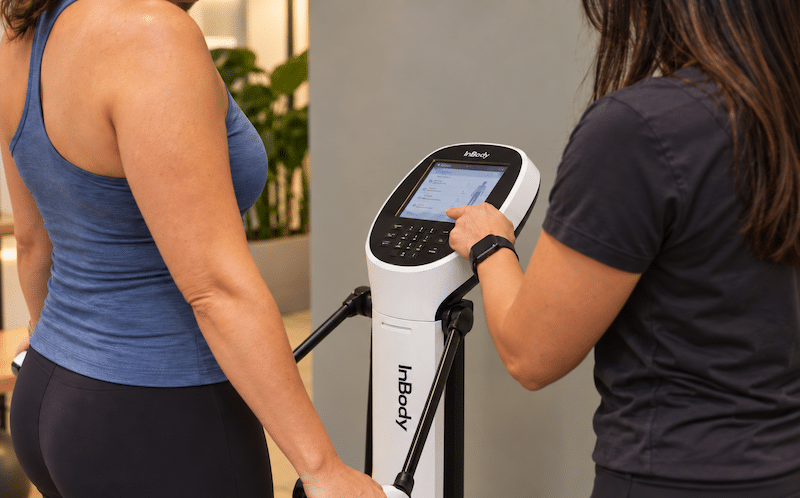
At Unite Fitness Retreat, we use the InBody 270 to assess body composition.
The InBody gives us additional information such as:
- Body weight
- Skeletal muscle mass
- Lean body mass
- Body-fat mass
- Percent body fat
- Body-water measures
We establish a baseline and then monitor trends throughout the guest’s stay.
That allows us to ask a much more useful question than:
“Did you lose weight this week?”
We can look at:
Did body fat decrease?
Was lean mass preserved?
Did muscle improve?
How is the trend changing over time?
That is a much more complete picture of progress.
You can read our full explanation here:
What Does an InBody Scan Measure?
Unite currently describes its approach as tracking muscle, fat and water rather than relying on scale weight alone.
The Scale Can Be Especially Misleading During Strength Training
Strength training creates some interesting scale situations.
As you begin exercising consistently, several things can happen.
Your muscles can store more glycogen.
Glycogen holds water.
Your body’s fluid balance can fluctuate.
Your body may be recovering from workouts.
You may be losing fat while preserving or adding lean tissue.
The result?
Your body can be changing even while the scale appears stubborn.
This is why weighing yourself every morning and allowing that number to determine whether yesterday was “good” or “bad” can become counterproductive.
Look at trends.
Not individual mornings.
Better Ways to Measure Progress Than Scale Weight Alone
The scale can stay.
It just shouldn’t work alone.
Consider tracking several measurements.
1. Body-Fat Percentage
Is your ratio of body fat to total weight improving?
2. Skeletal Muscle
Are you maintaining or improving muscle during weight loss?
3. Waist Circumference
Changes around the abdomen can provide useful information about fat loss.
4. Strength
Can you lift more?
Do more repetitions?
Use a heavier dumbbell?
Get up from the floor more easily?
5. Fitness
Can you walk farther?
Hike longer?
Recover more quickly?
6. Mobility
Are stairs easier?
Do your hips move better?
Can you squat, bend or reach more comfortably?
7. Clothing
Sometimes your jeans know before your bathroom scale does.
8. Energy
Do you feel stronger and more capable throughout the day?
9. Health Markers
Blood pressure, blood glucose, lipids and other metabolic markers may also provide useful information depending on your individual health.
Progress is a collection of data, not one number.
What Does Successful Weight Loss Actually Look Like?
For many adults, the best outcome isn’t:
“I weigh as little as possible.”
It’s closer to:
I have less excess body fat.
I have more—or at least preserved—muscle.
I’m stronger.
My waist is smaller.
My fitness is better.
I have more energy.
I sleep better.
I can move without feeling exhausted.
My habits are realistic enough that I can continue them.
That is a very different definition of success.
And a much more useful one.
What About GLP-1 Weight Loss?
This conversation has become particularly important as medications such as semaglutide and tirzepatide have become more widely used for weight management.
These medications can be highly effective for appropriately selected patients under medical care.
But any substantial weight-loss process raises an important question:
What is happening to lean mass while the weight is coming off?
That is why body composition, strength training, protein intake, hydration and recovery deserve attention alongside the scale.
At Unite, our Medical Weight Loss Retreat combines medical oversight when appropriate with resistance training, nutrition education and body-composition tracking. The program specifically includes muscle-preserving strength work and body-composition assessments.
Internal link: Medical Weight Loss Retreat
Why a Fitness Retreat Should Measure More Than Pounds Lost
If you’re considering a weight loss retreat or fitness retreat, ask how they define success.
Is everything centered around the scale?
Or are they also looking at:
- Body fat
- Muscle
- Strength
- Fitness
- Mobility
- Nutrition habits
- Sleep
- Stress
- Confidence
- Sustainability after you return home
At Unite Fitness Retreat in Salt Lake City, the objective isn’t simply to make guests lighter.
It’s to help them become leaner, stronger, fitter and better prepared to maintain their progress at home.
The program combines:
- Personalized strength and conditioning
- Daily Wasatch Mountain hiking
- Chef-prepared nutrition
- Protein-forward meals
- Body-composition assessments
- Yoga and mobility
- Recovery
- Mindfulness
- Life coaching
- Nutrition education
- Sustainable habit change
That whole-person approach is why body composition matters so much to us.
Because when someone loses weight, we want to understand what they actually lost.
A Better Question to Ask the Scale
You don’t need to throw your bathroom scale away.
You don’t need to pretend body weight doesn’t matter.
And you don’t need to become obsessed with body-fat percentages either.
The goal is perspective.
Instead of asking:
“Why didn’t I lose more weight?”
Try asking:
“Am I becoming healthier, stronger and leaner?”
Those answers may show up in places the scale can’t see.
And sometimes the most meaningful transformation isn’t becoming a much smaller version of yourself.
It’s becoming a stronger one.
Frequently Asked Questions About Muscle and Weight Loss
Can you lose weight without losing muscle?
It is difficult to guarantee that absolutely no lean tissue will be lost during weight loss, but resistance training, adequate protein, appropriate nutrition and a reasonable pace of weight loss can help support muscle preservation.
Can you lose fat without losing weight?
Yes. Someone who loses body fat while maintaining or gaining lean mass may see relatively little change in total body weight. This is one reason body composition and strength can provide useful information alongside scale weight.
Is gaining muscle while losing fat possible?
For some people, yes. This is often called body recomposition and may be particularly achievable for people who are new to resistance training, returning after time away or beginning a structured fitness program.
Why am I getting smaller but not losing weight?
Changes in body composition, fluid balance, glycogen storage and muscle can all affect total body weight. Measurements such as waist circumference, body-fat percentage, muscle mass, clothing fit and strength may help clarify whether your body is changing.
Does muscle weigh more than fat?
A pound of muscle and a pound of fat both weigh one pound.
The difference is density.
Muscle takes up less physical space than the same weight of fat, which is why someone can become smaller in measurements without seeing an equally dramatic change on the scale.
Should I stop weighing myself?
Not necessarily. Scale weight can be useful when viewed as a trend rather than a daily judgment. Pair it with body composition, strength, waist measurements, fitness and other health indicators.
Is BMI the same thing as body-fat percentage?
No. BMI uses height and weight to categorize body size. It does not directly measure body fat or muscle. Body-fat percentage estimates the proportion of total body weight that comes from fat.
Why is strength training important during weight loss?
Resistance training provides a stimulus that helps maintain strength and muscle. This can be especially important during calorie restriction and as adults age.
How does Unite measure weight-loss progress?
Unite uses weekly body-composition assessments alongside scale weight, fitness testing and coaching observations. The goal is to evaluate changes in body fat, muscle, fitness and overall progress rather than relying on pounds alone.
Stop Chasing Only the Scale
If your goal is lasting weight loss, don’t just ask how much weight you’re losing.
Ask what you’re building along the way.
At Unite Fitness Retreat, our all-inclusive fitness and weight loss program combines personalized strength training, body-composition tracking, chef-prepared nutrition, daily hiking, recovery and sustainable habit education.
Because the goal isn’t simply to weigh less.
It’s to leave stronger.